Our Short List of 3

- Best for: Hunters who want a light, simple scope for timber and shots inside 250 yards.
- Magnification: 3-9x, objective lens diameter: 40 mm
- Reticle: Dead-Hold BDC (MOA), second focal plane
- Tube size: 1 inch, one-piece aircraft-grade aluminum tube
- Item weight: 16 ounces

- Best for: Open-country hunters who want side focus and long eye relief at a mid-range size.
- Magnification: 4-16x, objective lens diameter: 42 mm
- Reticle: Dead-Hold BDC (MOA), second focal plane
- Eye relief: 4 inches
- Field of view: 23.8-6.1 feet at 100 yards

- Best for: Long-range target shooters and hunters who dial for every shot past 400 yards.
- Magnification: 6-24x, objective lens diameter: 50 mm
- Reticle: EBR-2C (MRAD), first focal plane
- Tube size: 30 mm, one-piece aircraft-grade aluminum tube
- Adjustment graduation: 0.1 MRAD, max elevation adjustment: 25 MRAD
All 4 Picks at a Glance
| Product | Specs | Action |
|---|---|---|
| Vortex Crossfire II 3-9×40 Dead-Hold BDC |
| Check price on Amazon |
| Vortex Diamondback HP 4-16×42 Dead-Hold BDC |
| Check price on Amazon |
| Vortex Diamondback Tactical 6-24×50 FFP EBR-2C MRAD |
| Check price on Amazon |
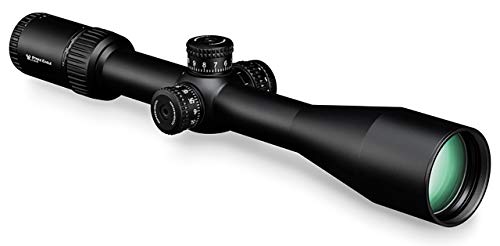 Vortex Strike Eagle 4-24×50 SFP EBR-4 MOA |
| Check price on Amazon |
Key takeaways
- Searching for the best Vortex scope for 7mm Rem Mag? Compare 5 Vortex riflescopes for elk and long-range hunting, with BDC and FFP reticles.
A 7mm Rem Mag hits hard at both ends: it reaches past 400 yards with authority, and it kicks hard enough to punish a scope mounted too close to your eye. That combination narrows the field fast. The right optic needs enough magnification for open-country shots, at least 3.5 inches of eye relief to keep your brow safe, and a reticle that gives usable holdover marks without turning the sight picture into clutter. Vortex covers that ground well, from the budget Crossfire II to the long-range Strike Eagle, and every model in this guide carries the same unconditional lifetime warranty.
This guide is for hunters sighting in a 7mm Rem Mag for elk, mule deer, and long-range target work, plus shooters building their first magnum rifle and wanting one scope that does the job. The five scopes below were chosen from names and specifications on their Amazon product pages, with an eye toward recoil handling, reticle usefulness at real hunting distances, and glass that holds up in low light.
Quick Picks
As an Amazon Associate we earn from qualifying purchases
| Product | Best for | Key spec from title |
|---|---|---|
| Vortex Crossfire II 3-9×40 Dead-Hold BDC | Timber hunting and a first magnum scope | 3-9×40 Dead-Hold BDC |
| Vortex Diamondback 4-12×40 Dead-Hold BDC | All-around elk and deer hunting | 4-12×40 Dead-Hold BDC |
| Vortex Diamondback HP 4-16×42 Dead-Hold BDC | Open-country shots with side focus | 4-16×42 Dead-Hold BDC |
| Vortex Diamondback Tactical 6-24×50 FFP EBR-2C MRAD | Long-range target work and dialing | 6-24×50 FFP EBR-2C MRAD |
| Vortex Strike Eagle 4-24×50 SFP EBR-4 MOA | Illuminated long-range hunting | 4-24×50 SFP EBR-4 MOA |
How to Choose
Match Magnification to Your Hunting Distance
A 3-9×40 scope covers timber and shots inside 250 yards, where a wide field of view matters more than raw power. Step up to 4-12x or 4-16x when your country opens up and shots past 300 yards are normal, since the extra top end lets you judge an animal before committing to the shot. Scopes that reach 24x belong to long-range target work and open-basin hunting, where you have time to settle and a stable rest. More magnification also means a narrower view and a dimmer image at dusk, so pick the lowest top end that still covers the longest shot you actually take.
Demand Enough Eye Relief for Magnum Recoil
The 7mm Rem Mag is famous for scope bite, and eye relief is the number that keeps your forehead intact. Look for at least 3.5 inches of eye relief, and treat 4 inches as the comfortable standard for a hard-kicking magnum. Eye relief also shrinks as magnification rises on most scopes, so check the figure at maximum power rather than at the low end. A forgiving eye box matters just as much, because a scope that forces you to hunt for the sight picture in a hurry costs you the shot. Mount the scope as far forward as your rings allow while keeping a full image at your natural cheek weld.
Pick a Reticle That Matches How You Shoot
A Dead-Hold BDC reticle gives simple holdover dots that work well for hunters who hold over rather than dial, and it stays uncluttered at low magnification. A first focal plane reticle like the EBR-2C keeps its holdover and windage marks accurate at every magnification setting, which suits shooters who range, dial, and hold wind at long distance. Illumination helps at dawn and dusk, when a black reticle can vanish against a dark animal, but it adds weight and a battery to manage. Choose the reticle system you already understand, because a clever reticle you cannot read quickly is worse than a simple one you trust.
Check Tube Size, Turrets, and Parallax
A 1-inch tube keeps a hunting scope light and lets it sit low on the rifle, which suits a carry rifle that covers miles on foot. A 30mm tube gives more elevation and windage travel for long-range dialing, and it usually comes with larger turrets. Capped turrets stay put in brush and are the right call for a hunting rifle, while exposed tactical turrets with a zero reset suit shooters who dial for every shot. Side-focus parallax adjustment matters once magnification passes 12x, because parallax error grows with power and distance. Confirm the parallax range reaches down to the closest distance you shoot.
The 5 Best Options
Vortex Crossfire II 3-9×40 Dead-Hold BDC
- Best for: Hunters who want a light, simple scope for timber and shots inside 250 yards.
- Magnification: 3-9x, objective lens diameter: 40 mm
- Reticle: Dead-Hold BDC (MOA), second focal plane
- Tube size: 1 inch, one-piece aircraft-grade aluminum tube
- Item weight: 16 ounces
Hunters who want a light, simple scope for timber and shots inside 250 yards.
The listing page did not show the buy box directly, so confirm the scope is in stock and check the eye relief at 9x before mounting.
The Crossfire II 3-9×40 is the sensible starting point for a 7mm Rem Mag that hunts timber and broken country. Its 3-9x range covers the distances most elk are actually shot at, and the wide field of view at 3x makes finding an animal in brush fast. The Dead-Hold BDC reticle gives simple holdover points for longer shots without clutter, and the one-piece tube, O-ring seals, and nitrogen purging handle rain and cold mornings. It is the lightest scope in this guide, which matters on a rifle you carry all day.
Vortex Diamondback 4-12×40 Dead-Hold BDC
The Diamondback 4-12×40 is the all-around pick for a 7mm Rem Mag that does a bit of everything. Four power at the bottom end is still wide enough for a close shot in timber, and 12x at the top gives enough detail to judge a bull or a buck across a canyon. The Dead-Hold BDC reticle keeps holdover simple, the capped turrets stay put when the rifle rides in a scabbard or leans against a pack, and the fully multi-coated lenses pull in enough light for the first and last minutes of legal shooting light. It balances well on a standard-weight hunting rifle without making the setup top-heavy.
Specs
- Magnification: 4-12x, objective lens diameter: 40 mm
- Reticle: Dead-Hold BDC (MOA), second focal plane
- Tube size: 1 inch, one-piece tube
- Capped turrets with finger-adjustable 1/4 MOA clicks
- Fully multi-coated lenses for bright, clear images
- Waterproof, fogproof, and shockproof construction
- Unlimited, unconditional lifetime warranty
- Part number: DBK-04-BDC
Best for: Hunters who want one scope for timber, open basins, and everything between.
Watch out for: The Amazon stock for this exact listing was not directly confirmed, so glance at the live listing before ordering.
ASIN: B001EC7KMY
Vortex Diamondback HP 4-16×42 Dead-Hold BDC
- Best for: Open-country hunters who want side focus and long eye relief at a mid-range size.
- Magnification: 4-16x, objective lens diameter: 42 mm
- Reticle: Dead-Hold BDC (MOA), second focal plane
- Eye relief: 4 inches
- Field of view: 23.8-6.1 feet at 100 yards
Open-country hunters who want side focus and long eye relief at a mid-range size.
The 1-inch tube limits elevation travel compared with 30mm scopes, so check the travel if you plan to dial past 500 yards.
The Diamondback HP 4-16×42 adds side-focus parallax adjustment and extra-low dispersion glass to the proven Diamondback formula, and that combination suits a 7mm Rem Mag used in open country. The 4-16x range reaches far enough for 400-yard shots while staying usable at 4x for closer work, and the side focus lets you sharpen the image and remove parallax error at any distance from 30 yards out. Four inches of eye relief is generous for a magnum, and the 80 MOA of elevation travel leaves room to dial for long shots. At 18 ounces it is still light enough to carry.
Vortex Diamondback Tactical 6-24×50 FFP EBR-2C MRAD
- Best for: Long-range target shooters and hunters who dial for every shot past 400 yards.
- Magnification: 6-24x, objective lens diameter: 50 mm
- Reticle: EBR-2C (MRAD), first focal plane
- Tube size: 30 mm, one-piece aircraft-grade aluminum tube
- Adjustment graduation: 0.1 MRAD, max elevation adjustment: 25 MRAD
Long-range target shooters and hunters who dial for every shot past 400 yards.
This ASIN sits on a parent listing with several Diamondback Tactical styles, so confirm the 6-24×50 MRAD style is selected in the cart before buying.
The Diamondback Tactical 6-24×50 is the long-range specialist in this guide, built for shooters who range targets, dial elevation, and hold wind. Its first focal plane EBR-2C reticle keeps every holdover and windage mark true at any magnification, which is exactly what you want when a shot stretches past 500 yards. The 50mm objective gathers light at high power, the 30mm tube gives generous adjustment travel, and the side parallax focuses down to 20 yards. This is a heavier, more deliberate scope, best on a rifle that spends most of its time on a bipod or a bench rather than slung over a shoulder.
Vortex Strike Eagle 4-24×50 SFP EBR-4 MOA
- Best for: Hunters who want one scope for dawn-to-dusk shooting and long-range holdover work.
- Magnification: 4-24x, objective lens diameter: 50 mm
- Reticle: EBR-4 (MOA), second focal plane, illuminated with 11 brightness levels
- Tube size: 30 mm, one-piece aircraft-grade aluminum tube
- Item weight: 1.6 pounds
Hunters who want one scope for dawn-to-dusk shooting and long-range holdover work.
At 3.5 inches the eye relief is the shortest in this guide, so mount it carefully and test the position at full power before hunting.
The Strike Eagle 4-24×50 pairs a huge magnification range with an illuminated EBR-4 reticle, making it the most versatile long-range hunting scope in this guide. At 4x it is wide enough for a closer shot, and at 24x it resolves a target far beyond normal hunting distance. The illuminated reticle runs through 11 brightness levels from the parallax knob, so the aiming point stays visible against a dark animal at dawn or dusk. The 30mm tube, tactical turrets with zero reset, and 80 MOA of elevation travel give you room to dial, while the glass-etched reticle stays clean and precise.
Which One Fits Your Situation
Hunting Elk in Thick Timber at Dawn
Pick the Crossfire II 3-9×40. Its wide view at 3x finds animals fast in brush, its light weight keeps the rifle handy on a steep climb, and the simple BDC reticle does not slow you down when a bull steps out at 80 yards. Save the high-magnification scopes for open country, where their strengths actually show.
Shooting Across Open Basins Past 300 Yards
Pick the Diamondback HP 4-16×42. The side focus sharpens the image at long distance, the 4 inches of eye relief forgives the recoil of a magnum, and 16x is enough to judge an animal across a canyon without the weight and bulk of a 24x scope. It is the most balanced open-country choice here.
Practicing Long Range and Developing Loads
Pick the Diamondback Tactical 6-24×50 FFP. The first focal plane reticle keeps holdovers true at every power setting, the MRAD turrets match the reticle for clean dialing, and the 50mm objective holds a bright image at 24x. Use it on a bipod or a bench, where its size and weight are not a burden.
Building Your First 7mm Rem Mag on a Budget
Pick the Diamondback 4-12×40. It covers timber and open country with one scope, the capped turrets survive hard field use, and the BDC reticle handles holdover without any dialing. If the budget is tighter still, the Crossfire II 3-9×40 gives up some top-end magnification and keeps the same warranty and build quality.
Common Mistakes
- Mounting the scope too close to your eye and taking a scope cut from magnum recoil, instead of checking eye relief at maximum magnification first
- Buying a 24x scope for timber hunting, where the narrow field of view makes finding an animal slower, not faster
- Ignoring parallax on a high-magnification scope and blaming the rifle for groups that wander at long distance
- Mixing MOA turrets with an MRAD reticle, or the reverse, and then wondering why the dialed correction does not match the hold
- Skipping a proper zero and torque check on rings and bases, then discovering a loose mount after a long hike to a shooting position
Frequently Asked Questions
What magnification is best for a 7mm Rem Mag?
A 3-9x or 4-12x scope covers most hunting, from timber to open basins, and keeps the rifle light and handy. Move to 4-16x when shots past 300 yards are common, and save 6-24x for dedicated long-range target work. More magnification narrows the field of view and dims the image at dusk, so the best choice is the lowest top end that still covers your longest realistic shot.
Is a BDC reticle accurate for 7mm Rem Mag loads?
A BDC reticle gives approximate holdover points that work well inside 400 yards with common 7mm Rem Mag loads, but the marks are calibrated for a typical trajectory rather than your exact load. Confirm the holdover points at the range with your own ammunition before hunting, and treat the dots as a starting point. Shooters who need exact corrections should dial with a matching turret system instead.
Do I need a 30mm tube for a 7mm Rem Mag?
No, a 1-inch tube is fine for most hunting, and it keeps the scope lighter and lower on the rifle. A 30mm tube earns its place when you dial for long-range shots, because it provides more elevation and windage travel and usually comes with larger, easier-to-read turrets. If you hold over with a BDC reticle instead of dialing, the extra travel of a 30mm tube adds little.
Can I use a first focal plane scope for hunting?
Yes, and the Diamondback Tactical in this guide shows why: its holdover marks stay accurate at every magnification, which matters when you change power in the field. The trade-off is that the reticle looks thin at low power and thick at high power, so it takes practice to read quickly. Hunters who shoot mostly at one magnification may prefer a second focal plane scope sized for that setting.