Key takeaways
- Build a full library wall with modular bookcases that grow bay by bay. Compare five expandable wall systems on module size, shelf loads and wall fixing.
A long, empty wall exposes the weakness of ordinary bookcases: one fixed-width unit either stops short of the corners or forces you into expensive built-ins. Modular wall bookcases solve that decision differently. You buy one bay, one cube grid or one floating tile, mount it, and then repeat the same module until the wall is covered, adding more later if the collection keeps growing. The real choice is which module logic fits your books, your wall construction and the load each shelf can honestly carry.

This guide is for readers filling a wide living-room, office or bedroom wall with books rather than a few paperbacks. Every pick below is sold as a modular or expandable wall system on its Amazon page, and the specs quoted come from those product titles and listing details, including per-shelf weight limits and mounting requirements.
Quick Picks
As an Amazon Associate we earn from qualifying purchases
| Product | Best for | Key spec from title |
|---|---|---|
| Nathan James Theo 6-Shelf Tall Bookcase | Lining up matching bays across a long wall | 6 shelves, 55 lb weight limit per shelf |
| Nathan James Benji 3-Tier Floating Wall Shelf | A rearrangeable display wall in solid wood | Solid rubberwood, fully adjustable shelves |
| ClosetMaid Cubeicals 12-Cube Organizer | Mixing open books with fabric-bin storage | 12 cubes, units combine side by side |
| DBD 4-Cube Wall-Mount Shelf Unit | Hanging a compact cube block above furniture | Wall-mount or floor standing, modular design |
| C&AHOME 16-Cube Storage Organizer | Reconfiguring the layout without new furniture | 16 DIY cubes, 48.4 in square footprint |
How to Choose
Decide how the modules multiply
Modular systems grow in three different ways, and the growth pattern decides how the finished wall looks. Ladder-style bays such as the Theo repeat as identical towers, so a ten-foot wall becomes four matching columns with clean vertical seams. Cube grids grow by combining whole units side by side or stacking smaller ones, which suits mixed storage. Floating tiles grow in any direction, letting you step the pattern around windows or a television. Pick the pattern first, because modules from different systems never align in depth, finish or shelf spacing.
Read the per-shelf load, not the headline number
Books are far heavier than the decor in most listing photos. A shelf rated at 55 pounds, like each tier of the Theo, can take a full row of hardcovers, while a plastic cube rated at 11 pounds per cube is really a paperback-and-keepsakes system. Total weight limits can also mislead: a wall-hung cabinet may carry less than the same unit standing on the floor, as the DBD cube unit shows with its separate wall-hung maximum. Match the per-shelf figure to your heaviest row of books, not to the average shelf.
Plan the wall fixing before the layout
Every system here depends on the wall doing real work. The Theo listing instructs buyers to secure the frame to a wall stud, cube units must be anchored so a tall stack cannot tip, and the DBD unit states plainly that it must be secured to the wall with fixings suited to your wall material, sold separately. Stud spacing may force you to shift a bay a few inches left or right, so map studs across the whole wall first and let that grid, not the furniture catalogue, set your module positions.
Measure openings against your tallest books
Shelf depth and opening height quietly rule out many pretty systems. Wall units are shallower than freestanding bookcases, often around ten to twelve inches, so oversized art books and atlases can overhang or simply not fit. Cube openings are fixed squares: roughly eleven-inch cubes swallow standard novels but reject tall hardcovers, while the DBD unit’s wider compartments take bigger formats. Measure your ten tallest books and your deepest shelf row before ordering, and reserve one flexible system, such as the adjustable Benji, for the awkward sizes.
The 5 Best Options
Nathan James Theo 6-Shelf Tall Bookcase
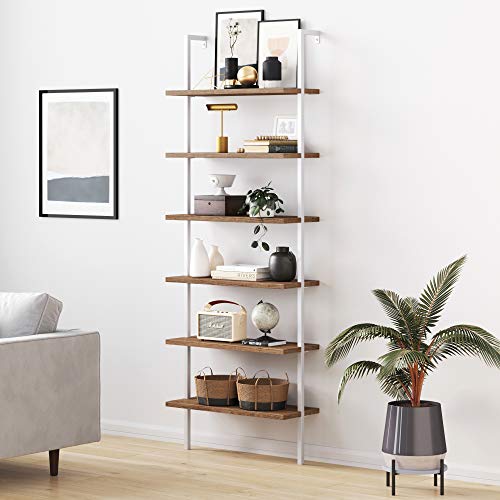
The Theo is the clearest expression of the modular idea in this group: a thirty-inch-wide, six-shelf ladder bookcase designed, in the maker’s own words, to be lined up with several matching units until they form one complete modular wall. The industrial frame pairs matte metal with laminate wood shelves, and each shelf carries a stated fifty-five-pound limit, which is genuine book territory rather than display-only storage. Assembly is quoted at about forty minutes with hardware included, so repeating the process across three or four bays stays realistic for a weekend project.
Specs
- Shelves: 6 fixed shelves in a wall-mount ladder frame
- Weight limit: 55 lb per shelf, 330 lb total
- Width: 30 in per bay
- Materials: engineered wood shelves with paper laminate, powder-coated metal frame
- Shelf thickness: 25 mm
- Mounting: wall mount, secured to a wall stud
- Assembly: about 40 minutes, hardware included, Phillips screwdriver required
Best for: A long living-room or office wall where you want identical bays and strong shelves for full rows of hardcovers.
Watch out for: The frame must be fixed into wall studs, so your bay spacing has to follow the stud grid rather than perfect symmetry.
Nathan James Benji 3-Tier Floating Wall Shelf
Where the Theo repeats rigid towers, the Benji treats the wall as a grid of solid-wood tiles. Each three-tier unit is built from solid rubberwood with a dado-style frame, and both the interior and exterior shelves are fully adjustable, so one tile can hold tall novels while its neighbour displays shorter paperbacks and objects. The listing explicitly invites buyers to mount several units side by side, vertically or horizontally, to build a statement bookcase wall. With a stated maximum weight capacity of one hundred twenty pounds per unit, it is the flexible, furniture-grade option for walls that need to evolve.
Specs
- Shelves: 3 tiers, solid rubberwood construction
- Shelf layout: fully adjustable interior and exterior shelves
- Orientation: mount horizontally or vertically, combine multiple units
- Weight capacity: 120 lb maximum
- Mounting: wall mount on keyhole brackets
- Unit weight: 22 lb
- Assembly: required
Best for: Readers who want a warm solid-wood wall they can rearrange as the collection changes shape.
Watch out for: Each tile is only three shelves, so covering a large wall takes several units and careful levelling to keep the pattern aligned.
ClosetMaid Cubeicals 12-Cube Organizer
Cubeicals is the established cube ecosystem: the range runs from two cubes up to this twelve-cube unit, and ClosetMaid sells the pieces as a family you combine over time. The twelve-cube organizer can stand vertically or horizontally, and the listing notes that units can be placed side by side to create a large storage area, which is exactly how a wide wall gets filled in stages. Open cubes take books and display pieces, while matching Cubeicals fabric drawers, sold separately, turn selected cubes into closed storage for chargers, games and clutter you would rather not exhibit.
Specs
- Compartments: 12 cube openings in an open-back design
- Finish: white wood laminate
- Display: vertical or horizontal orientation
- Expansion: place units side by side to create a large storage area; range spans 2 to 12 cubes
- Included: 12-cube organizer with assembly and installation hardware
- Model: Cubeicals 1290
- Accessories: compatible with Cubeicals fabric drawers, sold separately
Best for: Family walls that mix open book storage with hidden bin storage, built up unit by unit.
Watch out for: This is a floor-supported cube wall rather than a floating unit, so plan on anchoring it to the wall for stability and keeping heavy books low.
DBD 4-Cube Wall-Mount Shelf Unit
This four-cube unit follows the familiar Kallax-style format and is unusually honest about hanging: its listing describes a modular design that can be mounted on the wall or placed on the floor, and it publishes separate load figures for each role. As a wall-hung cabinet the maximum load is forty-four pounds, while each shelf holds up to twenty-nine pounds and the top surface fifty-five. The honeycomb-core panels keep the unit light enough to hang, and the compartments accept Kallax inserts and accessories, so doors, baskets and dividers from that ecosystem can be added later.
Specs
- Compartments: 4 cubes, each 13.25 in wide
- Overall size: 30.125 x 15.375 x 30.125 in
- Load limits: 29 lb per shelf, 55 lb on top, 44 lb maximum wall-hung
- Materials: particleboard and fiberboard with honeycomb paper filling, acrylic paint finish
- Mounting: wall mount or freestanding; must be secured to the wall
- Fixings: wall fixing devices sold separately
- Compatibility: works with Kallax inserts and accessories, sold separately
Best for: Hanging a compact cube block above a desk, sofa or reading chair where floor space is already taken.
Watch out for: The wall-hung load limit is the lowest figure on the page, so a fully loaded hanging unit should hold lighter books, not your densest reference rows.
C&AHOME 16-Cube Storage Organizer
The C&AHOME system takes modularity furthest: fifty-six plastic panels, a rust-proof metal frame and fifty ABS connectors click together with the included wooden mallet into sixteen cubes, and the listing shows several layout variations built from the same parts. Arranged square, the unit covers about forty-eight inches in each direction, and you can restack the cubes into a wider, lower wall whenever the room changes. This freedom comes with a firm trade-off, because each cube is rated for a maximum of eleven pounds, making it a system for paperbacks, magazines and display pieces rather than dense hardcover rows.
Specs
- Cubes: 16, DIY layout with multiple configuration options
- Overall size: 48.4 x 12.4 x 48.4 in in square layout
- Materials: PP plastic panels, rust-proof metal frame, ABS connectors
- Load limit: 11 lb maximum per cube
- In the box: 56 panels, 50 connectors, 1 wooden mallet
- Assembly: required, tool-light connector build
Best for: Renters and rearrangers who want a big, light cube wall they can rebuild into a new shape without buying new furniture.
Watch out for: The eleven-pound per-cube limit is real; a cube stuffed with hardcovers can sag, so spread heavy books across several cubes or choose a wood system.
Which One Fits Your Situation
You are covering one long, straight library wall
Choose the Nathan James Theo and repeat it bay by bay. Four thirty-inch units span ten feet with no gaps, every shelf carries the same fifty-five-pound rating, and the matching finishes keep the wall reading as one piece of furniture rather than a collection of compromises.
Your wall has windows, doors or a television in the way
Choose the Nathan James Benji tiles. Because each unit mounts independently and works horizontally or vertically, you can step the pattern over a doorway, flank a screen symmetrically, or leave a gap for artwork, then fill the remaining space later with more matching tiles.
Half the wall is books and half is everyday clutter
Choose the ClosetMaid Cubeicals 12-Cube, possibly paired with a second unit beside it. Open cubes display the books you reach for, while fabric drawers hide cables, toys and paperwork behind a tidy front, and the range’s smaller sizes let you extend into awkward leftover spaces.
You need storage now but may move or reconfigure soon
Choose the C&AHOME 16-Cube if your load is mostly paperbacks, or the DBD 4-Cube if you need a smaller wall-hung block. The C&AHOME rebuilds into new shapes with no extra parts, while the DBD can come off the wall and stand on the floor in the next home.
Common Mistakes
- Multiplying the per-shelf limit by the number of shelves and assuming the wall anchors will hold that total; anchors and wall material set the real ceiling.
- Hanging or stacking a tall cube unit without its wall anchor, then loading the top cubes with the heaviest books.
- Buying modules from two different systems for one wall; depths, finishes and shelf spacing will not line up, and the seams show.
- Ignoring shelf depth and cube height until delivery day, when the atlases and tall hardcovers have nowhere to go.
- Ordering one finish today and expecting an identical match from a second purchase years later; buy spares for planned extensions early.
Frequently Asked Questions
How many modules do I need for a ten-foot wall?
Work in module widths from the listings. Theo bays are thirty inches wide, so four bays cover ten feet exactly. The C&AHOME square layout is about forty-eight inches wide, so two units plus a restacked section get you close. Always measure your own wall first, because skirting boards, outlets and stud positions usually steal a few inches from the theoretical layout.
Can modular wall bookcases go on drywall without studs?
Only the lightest tiles should even be considered, and only with anchors rated for the loaded weight. The Theo listing tells buyers to secure the frame to a wall stud, and the DBD unit requires fixings suited to your wall material. A wall of books is a serious sustained load, so studs or properly rated masonry fixings are the safe default.
Are cube systems strong enough for a serious book collection?
It depends on the cube. Wood cube shelves such as the DBD unit publish a twenty-nine-pound per-shelf limit, which handles ordinary book rows, while the plastic C&AHOME cubes are rated at eleven pounds each and suit paperbacks and lighter items. Check the per-cube or per-shelf figure on the listing, and keep encyclopedias in wood systems with the load spread out.
Can I add more modules later, or must I buy the whole wall at once?
Adding later is the point of these systems, and every pick here is sold as a repeatable module or a multi-size range. The practical risk is finish drift or a variant being renamed between purchases. If you already know the wall will grow, buy the extra bay or cube unit while the exact finish is current and store it flat.