Our Short List of 3

- Best for: Growers who want a complete, expandable tower kit from a single brand.
- Planter form: Vertical tower
- Material: USDA-approved, UV-stabilized, food-grade plastic
- Plant capacity: 20 plants in the base configuration
- Assembled size with growing extension: 62 x 30 x 30 inches
- Best for: Indoor growers who want timed lighting and watering in a footprint under three square feet.
- Plant capacity: 24 net pots
- Reservoir: 10-gallon tank with water gauge, on wheels
- Material: Food-grade, BPA-free
- Dimensions: 20 x 20 x 66 inches
- Best for: High-volume home growers who want the most planting ports per square foot.
- Plant capacity: 40 net pots (8 layers x 5 pots)
- Reservoir: 12-gallon tank with water gauge, on wheels
- Material: Food-grade, BPA-free
- Dimensions: 22 x 22 x 72 inches
All 3 Picks at a Glance
| Product | Specs | Action |
|---|---|---|
| Tower Garden FLEX Deluxe Vertical Aeroponic Planter |
| Check price on Amazon |
| ALTO GARDEN GX Hydroponic Tower |
| Check price on Amazon |
| ALTO GARDEN HX Aeroponic Tower |
| Check price on Amazon |
Key takeaways
- Compare the best large planters for aeroponics, from 20-plant towers to a 27-plant tent system, with net pot counts, tank sizes and footprints checked.
Choosing a large planter for aeroponics is really a decision about capacity versus upkeep: every extra planting port adds yield, but it also adds roots to inspect, nutrient solution to mix, and nozzles or pump cycles to keep clear. Buyers who size the system to the harvest they actually eat each week end up running it for years, while oversized towers bought on ambition often sit half empty and grow algae in the unused ports.
This guide is for home growers moving up from countertop herb units, balcony gardeners with limited floor space, and indoor growers who want a full tent setup. The four systems below were chosen from the names and specifications on their Amazon product pages, comparing plant capacity, reservoir size, footprint, and what each kit includes in the box.
Quick Picks
As an Amazon Associate we earn from qualifying purchases.
| Product | Best for | Key spec from title |
|---|---|---|
| Tower Garden FLEX Deluxe Vertical Aeroponic Planter | Growers who want one complete outdoor-capable tower kit | Vertical Aeroponic Planter |
| ALTO GARDEN GX Hydroponic Tower | Indoor growers who want automated light and water cycles | Hydroponic Tower with 24 Net Pots |
| ALTO GARDEN HX Aeroponic Tower | High-yield households filling a corner with greens | Aeroponic Tower with 40 Net Pots |
| Aerospring Indoor Hydroponic Growing System 2.0 | Indoor growers who want a tent, fan and lights included | Indoor Hydroponic Growing System 2.0 |
How to Choose
Plant Capacity Versus Weekly Harvest
Count planting ports honestly against what your household eats. A 20-port tower keeps a small family in salad greens and herbs, while 40 ports suit growers preserving, juicing, or feeding a larger household. Oversizing has a real cost: empty net pots let light reach the nutrient solution, which encourages algae, and a bigger canopy means more roots competing for the same misting cycle. Match the port count to a realistic weekly harvest, and remember that fruiting plants such as peppers occupy far more vertical room per port than lettuce or basil, so mixed crops reduce the usable capacity of any tower you pick.
Reservoir Size and Refill Rhythm
The reservoir decides how often you are mixing nutrient solution. Tanks around 10 to 12 gallons on the towers here typically need topping up every week or so in warm weather, while a 20-gallon reservoir stretches that interval considerably. A larger tank also buffers pH and nutrient concentration swings, which keeps roots in a steadier environment between checks. Look for a visible water gauge or an easy-fill opening, because lifting a full tower section to check levels gets old quickly. If you travel for work, reservoir size is the single spec most likely to decide whether plants survive your absence.
Footprint, Height and Light Access
Vertical planters trade floor space for height, so measure both. The towers in this guide stand roughly five and a half to six feet tall and take up about three to five square feet, which fits a balcony corner or a spare-room wall. Indoor models with built-in LED lights free you from needing a sunny window, but the light bars add height and heat that a low ceiling or enclosed closet may not handle. Tent-based systems need the most room of all, yet they contain light and humidity completely. Check the assembled dimensions on the listing against your space before ordering, not after.
What the Kit Includes
Two towers with similar port counts can differ sharply in the box contents. Starter kits that bundle net pots, rockwool cubes, seeds, nutrient blend, and a pH kit let you plant the day the box arrives, while bare systems leave you sourcing each consumable separately. Pumps, timers, and grow lights are the expensive pieces, so confirm whether each is included or sold as an add-on. Also check what is proprietary: systems built around one brand of nutrient blend or replacement tower sections tie you to that brand for refills, whereas standard net pot sizes can be replaced from almost any hydroponic supplier.
The 4 Best Options
Tower Garden FLEX Deluxe Vertical Aeroponic Planter
- Best for: Growers who want a complete, expandable tower kit from a single brand.
- Planter form: Vertical tower
- Material: USDA-approved, UV-stabilized, food-grade plastic
- Plant capacity: 20 plants in the base configuration
- Assembled size with growing extension: 62 x 30 x 30 inches
Growers who want a complete, expandable tower kit from a single brand.
Shipping is restricted to some regions per the listing, and refills use the brand’s own mineral blend.
This is the established name in home aeroponics, sold as a complete deluxe kit rather than a bare tower. The listing describes a patented aeroponic system that recirculates water and nutrients past roots suspended in net pots, and the Deluxe bundle layers on the extras most growers eventually buy anyway: LED grow lights, a support cage for heavier fruiting plants, a dolly for moving the tower, and a starter supply of the brand’s mineral blend. It suits buyers who want one box, one brand of support materials, and a system rated for indoor or outdoor placement.
ALTO GARDEN GX Hydroponic Tower
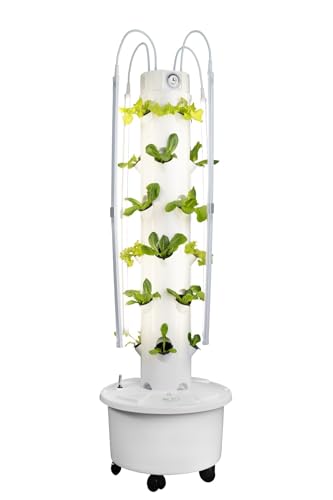
- Best for: Indoor growers who want timed lighting and watering in a footprint under three square feet.
- Plant capacity: 24 net pots
- Reservoir: 10-gallon tank with water gauge, on wheels
- Material: Food-grade, BPA-free
- Dimensions: 20 x 20 x 66 inches
Indoor growers who want timed lighting and watering in a footprint under three square feet.
The listing rates it for indoor use, so balcony growers should look at the outdoor-rated options instead.
The GX is a self-contained indoor tower built around automation. Its listing states that roots are suspended in net pots inside the tower for aeroponic growing, with a pump and timer cycling water to the top and gravity returning it through the root chamber. Twenty-four widely spaced ports give each plant more lateral room than densely packed towers, which helps bushier herbs and strawberries. Built-in LED grow lights carry their own timer, a water gauge shows the level in the 10-gallon tank, and the reservoir sits on wheels so the whole unit can be rolled aside for cleaning or closer to an outlet.
ALTO GARDEN HX Aeroponic Tower
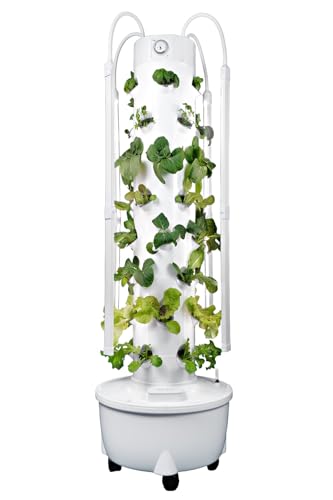
- Best for: High-volume home growers who want the most planting ports per square foot.
- Plant capacity: 40 net pots (8 layers x 5 pots)
- Reservoir: 12-gallon tank with water gauge, on wheels
- Material: Food-grade, BPA-free
- Dimensions: 22 x 22 x 72 inches
High-volume home growers who want the most planting ports per square foot.
At six feet tall and 41 pounds before water, confirm ceiling height and floor space first.
The HX is the GX concept scaled up for serious volume: eight layers of five ports give 40 planting sites in about three square feet, and the reservoir grows to 12 gallons with a stronger pump to push solution to the top of the taller column. The listing keeps the features that make the smaller tower manageable, including the water gauge, the light timer, and wheels under the tank, while widening each tower section so mature plants crowd each other less. Growers feeding a large household, or growing cut-and-come-again greens in rotation, are the audience this capacity is aimed at.
Aerospring Indoor Hydroponic Growing System 2.0
Aerospring takes a different route from the open towers: the planter is a hexagonal column inside a full grow tent, with 150W LED lights, a circulation fan, and a 20-gallon reservoir managing the environment as one package. The listing states the system uses aeroponic technology that increases airflow to the root zone, and it grows up to 27 plants, including fruiting crops that open towers struggle to support indoors. The powder-coated metal frame rides on a six-wheel base with lockable wheels. For growers in dark apartments or cold rooms, the tent’s controlled climate is the main reason to choose it.
Specs
- Plant capacity: Up to 27 plants
- Reservoir: 20 gallons
- Lighting: 6 LED grow lights, 150W
- Frame: Powder-coated metal, hexagonal
- Included: grow tent, circulation fan, wheelbase with 3 lockable wheels
- Package size: 29.13 x 33.46 x 73.62 inches
- Seller: Aerospring Gardens
Best for: Indoor growers who want a tent-contained system for greens and fruiting plants year-round.
Watch out for: The tent footprint is far larger than a bare tower, so measure the room before ordering.
ASIN: B0CLLB7328
Which One Fits Your Situation
You Grow Mostly Salad Greens and Herbs
The ALTO GARDEN GX covers this job well. Twenty-four ports match the pace at which most households actually harvest lettuce and basil, the timed lights and pump keep the routine nearly hands-off, and the 10-gallon tank only needs weekly attention. The Tower Garden FLEX also fits, but its deluxe bundle buys outdoor hardware a kitchen grower may never use.
You Feed a Big Household or Grow in Rotation
Pick the ALTO GARDEN HX. Forty ports let you stagger plantings so something is always at harvest size, and the 12-gallon reservoir keeps pace with a full canopy drinking heavily in warm rooms. Its wider sections give kale, chard, and peppers the elbow room that smaller towers deny them once the canopy closes in.
You Want Fruiting Plants Indoors All Year
The Aerospring 2.0 is the one designed for this. The tent traps light and warmth, the fan moves air across flowers, and the 20-gallon reservoir supports thirsty tomato and pepper roots without constant refills. Open towers can grow fruiting crops, but indoors they depend on whatever light and temperature the room happens to offer.
You Have a Sunny Balcony or Patio Corner
Choose the Tower Garden FLEX Deluxe. It is the only system here whose listing rates the build for outdoor placement, with UV-stabilized plastic and a support cage for top-heavy plants in wind. The dolly matters outside too, letting you rotate the tower or chase sunlight as the seasons shift across the balcony.
Common Mistakes
- Buying the largest tower available, then leaving half the ports empty where light grows algae in the reservoir.
- Ignoring assembled height, and discovering a six-foot tower plus light bar does not fit under the ceiling or shelf.
- Assuming every kit includes nutrients, seeds, and a pH kit, then waiting a week for consumables after assembly.
- Placing an indoor-rated tower on a balcony where its plastics and electronics were never listed for weather exposure.
- Skipping reservoir access checks; a tank you cannot easily see or refill leads to pumps running dry.
Frequently Asked Questions
Are these towers true aeroponic systems or hydroponic ones?
Listings use both words, sometimes for the same product. In these towers, roots hang in air inside the column and are bathed by pumped nutrient solution on a cycle, which is the aeroponic arrangement; the pump-and-drain delivery is why sellers file them under hydroponics. What matters is the pump, timer, and net pot design on the listing, not the label.
How many plants can a beginner realistically manage?
Start below the tower’s maximum. A first run of 12 to 20 greens and herbs teaches you nutrient mixing, pH checks, and harvest timing without the workload of a full 40-port canopy. Every system here can run partially filled, and adding ports later is easier than rescuing an overgrown tower whose roots have tangled into the pump intake.
Do I need grow lights if the tower sits near a window?
Leafy greens manage on strong window light in summer, but fruiting plants and winter herbs usually stall without supplemental lighting. Three of the four systems here include LED lights with timers, which removes the guesswork. If you choose a tower without lights for a bright patio, confirm the listing rates it for outdoor use before placing it outside.
What ongoing supplies do these planters need?
Expect a recurring list: nutrient solution matched to the system, rockwool cubes or another starter medium for each new seedling, replacement net pots as roots crack old ones, and pH testing supplies. Brand-specific kits such as the Tower Garden mineral blend simplify reordering, while towers using standard net pot sizes let you buy generic replacements from any hydroponic supplier.