Key takeaways
- Find contractor table saws with dust extraction ports, with a verified jobsite pick, port and fence specs, and practical setup guidance for cleaner cutting.
As an Amazon Associate we earn from qualifying purchases.
Disclosure: This article contains affiliate links. If you buy through these links, we may earn a commission at no additional cost to you.
A contractor table saw lives a harder life than a shop saw. It gets loaded into a truck bed or a van, carried across uneven ground, set up on a driveway, a garage floor, or a half-finished room, and then asked to rip sheet goods and dimensional lumber accurately all day. Add dust extraction to that picture and the saw has to do one more job well: move the chips and fine dust it creates away from the blade, away from the operator, and into a container or a vacuum instead of into the air and across the floor. This guide looks at what a dust extraction port actually does on a jobsite saw, how to judge whether a port is genuinely useful or just a shaped piece of plastic, and which verified contractor and jobsite table saw currently meets the brief on Amazon US.
Every product considered for this guide had to meet three conditions. First, it had to be a contractor or jobsite table saw, the portable class of saw built around a stand, folding legs, or wheels so it can travel between sites. Second, a dust extraction or dust collection port had to be stated on its own Amazon product page, in the page’s own description, feature material, or included components list, not inferred from a photograph or borrowed from a different model. Third, the product page had to show the saw as buyable, with its ASIN stated in the product information on that page. Several familiar names did not clear those conditions on the pages actually read during research, and they are not listed here on reputation alone. That strict filter leaves a short list, and a short honest list is more useful than a long guessed one.
Our Verified Pick
SKIL 15 Amp 10 Inch Portable Jobsite Table Saw with Folding Stand, TS6307-00
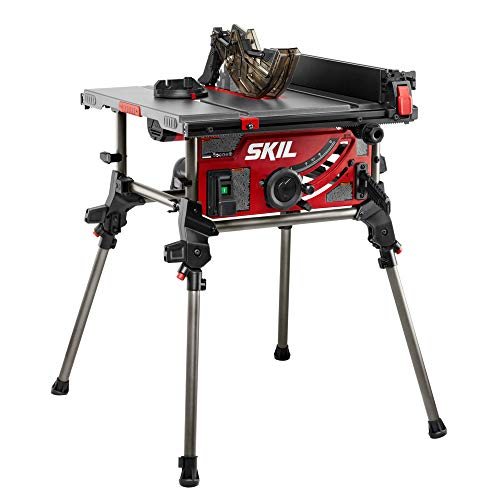
The SKIL TS6307-00 is a 10-inch portable jobsite table saw, and its product page describes it in exactly those terms, as a jobsite saw with a folding stand. For a contractor, that jobsite framing matters more than any single specification. The saw is built to be moved, set up, used hard, and folded away again, and its dust handling is designed around that same pattern of work.
The dust feature stated on the page is a dust port elbow. The page says the dust port elbow systematically redirects dust to a container for easy cleanup, and the included components list names the dust port elbow as a part supplied in the box, alongside the blade guard, push stick, miter gauge, anti-kickback pawl, wrenches, riving knife, rip fence, and the fitted blade. That combination is worth noting. A port that appears both in the feature description and in the box contents is a working part of the saw’s dust route, not an accessory you have to hunt down separately before the saw can be used with any kind of extraction or collection at all. The elbow shape is also practical on site. Instead of spraying chips straight out of the back of the saw in a wide fan, an elbow turns the stream downward and in one direction, so the waste lands in a defined place, in a container placed under or behind the saw, rather than across the whole work area. On a finished floor, on a client’s driveway, or inside a room that is being remodelled rather than built from scratch, that difference between scattered waste and directed waste is the difference between a quick sweep and a long clean-up.
Power and capacity on the page are squarely in contractor territory. The motor is rated at 15 amps, and the page describes it as ripping through hardwoods with ease. The fitted blade is a 10-inch, 24-tooth carbide blade. Rip capacity is stated at 25-1/2 inches, which is enough to rip a full sheet in half lengthwise with the fence doing the guiding, the most common sheet task on most sites. Bevel capacity runs from 0 to 45 degrees, with a quick release lever and two positive stops at 0 and 45 degrees, so returning to a square cut after a bevel cut is a defined stop rather than a guess. Cutting capacity is given as a maximum depth of 3-1/2 inches at 0 degrees and 2-1/2 inches at 45 degrees, and the page states a 4×4 cutting capacity at 90 degrees, which covers the posts and framing sections a contractor is most likely to put through a portable saw. When a dado insert is used, the page notes that the saw requires an 8-inch dado blade set, a detail worth knowing before a dado set is ordered for it.
The fence system is a rack and pinion design. The page says the rack and pinion fence rails make fence adjustments fast, smooth, and accurate. On a jobsite saw this is not a luxury feature. A fence that drifts, sticks, or needs to be measured at both ends on every move costs time on every cut and invites tapered rips. A geared fence that moves both ends together and locks in parallel is the single biggest accuracy upgrade a portable saw can offer, and it is the feature experienced users tend to check first. The SKIL also offers parallel blade alignment, which the page describes as allowing ease of blade adjustment along the rip fence and miter slot for precise, accurate cuts. That means the blade itself can be brought into line with the miter slot, so the fence, the slot, and the blade can all agree with each other instead of the user compensating for a fixed misalignment.
Portability is handled by integrated folding legs. The page says the integrated foldable legs seamlessly form into a folding stand to provide portability and convenience. Because the legs are part of the saw rather than a separate stand to assemble, carry, and occasionally leave behind, setup is a matter of unfolding and locking rather than building. The saw’s stated weight is 51.2 pounds, and its stated dimensions are 28.74 inches long by 27.17 inches wide by 16.93 inches high, a footprint that fits the reality of transport and storage between jobs. The tabletop is described as a large coated cast aluminum tabletop, which gives a flat, durable working surface without the weight of a cast iron top that would defeat the point of a portable saw. A safety anti-restart switch is also stated on the page, described as protection in case of power outages, so the saw does not restart on its own when power returns after an interruption, a real consideration on sites where breakers trip and generators stop and start. The page lists a limited warranty for the saw, and names the manufacturer as SKIL.
Taken together, the TS6307-00 fits this keyword for specific, page-stated reasons: it is a portable jobsite table saw, it has a dust port elbow stated in its features and in its box contents that redirects dust to a container, and it pairs that dust route with the fence, capacity, and folding stand a contractor actually uses. If your work is mostly sheet goods, framing sections, trim, and general site carpentry, and you want the waste stream directed instead of scattered, this is the verified pick to start from.
Why a Dust Extraction Port Matters on a Jobsite Saw
Sawdust on a jobsite is not just untidiness. Fine dust hangs in the air of enclosed rooms, settles on finished surfaces that then need cleaning or refinishing, coats the floor where people walk, and gets into the saw’s own moving parts. A dust port gives that waste a planned exit. Instead of leaving the blade housing wherever momentum throws it, the port collects the stream at the back or underside of the saw and sends it through an elbow or a hose in one chosen direction.
There are two levels of dust control to understand when you compare saws. The first level is direction. A simple port or elbow, like the one stated for the SKIL above, turns an uncontrolled spray into a controlled stream aimed at a container. That alone keeps the immediate area around the saw far cleaner and makes sweeping up a single pile instead of a whole room. The second level is extraction, where a vacuum or extractor is connected to the port so dust is actively pulled away as it is made. Whether a given port accepts a hose, and what size it takes, is a specification to confirm on the product page of the exact saw you are buying, because port designs differ between models that otherwise look similar. Do not assume that because one saw in a brand’s range takes a particular hose, another saw in the same range does too.
Dust control also protects the saw. Chips that pack into a blade housing can interfere with blade raising and tilting mechanisms and with guard movement. A port that keeps the waste stream moving out of the housing reduces that build-up, although no port removes the need to blow out or brush out a saw at the end of a heavy day. Think of the port as the first line of dust management, and regular cleaning as the second.
Finally, there is the client factor. Contractors who work in occupied homes are judged on how they leave a room as much as on the cut itself. A saw that directs its dust into a container, especially when paired with a vacuum on the port, is a visibly more professional tool in a finished space, and it reduces the protection and covering work needed before cutting starts indoors.
How to Choose a Contractor Table Saw with Dust Extraction
Start with the port itself. Confirm, on the product page, that a dust port, dust collection port, or dust port elbow is actually stated for that model, ideally both in the features and in the list of what is in the box. Then look at what the port does. Language that says a port redirects dust to a container describes direction. Language that gives a port diameter describes a hose connection. Both are useful, but they are not the same promise, and your setup should match the promise the page actually makes.
Next, judge the saw as a saw. Rip capacity decides the widest cut you can make with the fence, and for sheet work you want enough capacity to at least halve a standard sheet. Depth of cut at 90 degrees decides the thickest stock you can cut in one pass, and depth at 45 degrees decides the same for bevelled work. Bevel range and positive stops decide how quickly you can move between square and angled cuts. Motor amperage in this class is the practical power indicator, and a 15-amp motor is the established full-power format for corded jobsite saws.
Then judge the fence. A rack and pinion fence is the benchmark in this class because it keeps the fence parallel to the blade as it moves and makes repeat settings quick. Check whether the page mentions blade alignment adjustment as well, because a fence can only be as accurate as the blade it is aligned to.
Finally, judge the stand and the weight honestly against your own routine. Integrated folding legs minimise parts and setup steps. A separate rolling stand can be easier to move over rough ground but adds bulk. Weight matters if you lift the saw into a vehicle alone every day. Storage for the fence, guard, miter gauge, push stick, and wrenches on the saw itself keeps the small parts with the tool instead of scattered through a toolbox. None of these points is glamorous, and all of them decide whether a saw is still pleasant to use a year after it arrives.
Setting Up Dust Control on Site
Place the saw so the port faces the space where a container or vacuum can sit without blocking your stance or the path of long boards. A port that points into a wall or into your own legs wastes its advantage. If you are using the port with a container, position the container directly in the stream’s path and check it during long ripping sessions, because a full container under an elbow quickly becomes a pile that spreads. If you connect a vacuum or extractor, route the hose so it cannot be pulled across the blade path or tripped over, and confirm the fit at the port before the first cut rather than after the first cloud.
Work habits matter as much as hardware. Give the saw a moment at the end of a cut before moving the workpiece away, keep the blade guard in place so the waste stream stays directed toward the housing and port, and empty containers before they overfill. At the end of the day, clear the housing and the port opening, because compacted dust left overnight in damp site conditions hardens into a blockage that the next day’s work has to push against.
Frequently Asked Questions
Is a dust port elbow the same as a full extraction connection?
Not exactly. An elbow redirects the dust stream in a chosen direction, typically into a container, which is a major improvement over an uncontrolled spray. A port described with a diameter is usually intended for a hose connection to a vacuum or extractor for active extraction. Read the exact wording on the product page of the saw you choose so your expectations match its stated design.
Can a jobsite saw really serve as a contractor saw?
Yes, and in current product ranges the two labels describe the same class of machine: a portable, stand-mounted table saw powerful enough for site work. The SKIL pick in this guide is described on its page as a portable jobsite table saw, with a 15-amp motor, a 10-inch blade, and a folding stand, which is the contractor format in practice.
What rip capacity do I need for sheet goods?
To rip a standard sheet in half lengthwise you need a little more than half its width in fence capacity, plus working room. The verified pick here states 25-1/2 inches of rip capacity, which covers that central sheet cut and most shelving and trim widths. If your work regularly involves wider offcuts, compare rip capacity figures on product pages before choosing.
Does a dust port remove the need to clean the saw?
No. A port greatly reduces scattered dust and housing build-up, but fines still settle in the mechanism over time. Treat the port as continuous dust management during cutting and a brief manual clean-out as the finishing step each day.
What blade comes with the verified pick?
Its page states that the saw is equipped with a 10-inch, 24-tooth carbide blade, and lists that blade among the included components. The same page notes that dado work with a dado insert requires an 8-inch dado blade set.
Conclusion
The best contractor table saws with dust extraction ports are the ones where the port is a real, page-stated part of the saw, the fence is accurate enough for professional work, and the stand suits the way you actually travel and set up. On the evidence of the product pages read for this guide, the SKIL TS6307-00, ASIN B08F9RFJ2K, is the verified pick that meets all of those conditions: a 15-amp, 10-inch portable jobsite saw with a stated dust port elbow that redirects dust to a container, a rack and pinion fence, parallel blade alignment, integrated folding legs, and the depth and rip capacity that everyday site carpentry demands. Confirm the port description and the included components on its page before you order, set the saw up so the dust stream has somewhere planned to go, and it will cut cleanly in both senses of the word.