Our Short List of 3

- Best for: Pickup owners with a B&W Turnoverball already installed who want a removable 20,000 lb hitch.
- Model: RVK3500
- Mount: B&W Turnoverball underbed gooseneck system, sold separately
- Gross trailer weight capacity: 20,000 lb
- Vertical load capacity: 5,000 lb

- Best for: Ford Super Duty trucks with the factory prep package towing the heaviest fifth wheels.
- Model: RVK3305, made up of base RVB3305 and coupler RVC3006
- Mount: Ford OEM puck system
- Gross trailer weight capacity: 25,000 lb
- Vertical load capacity: 6,250 lb
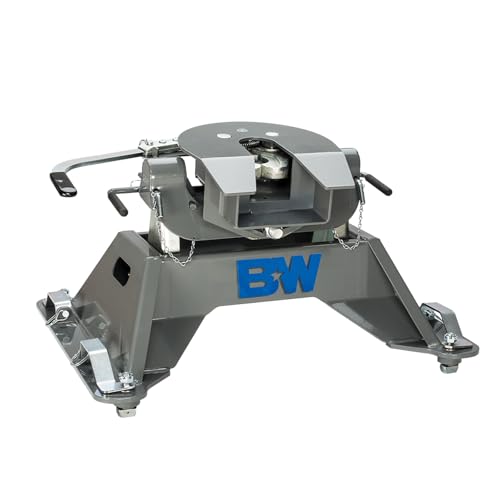
- Best for: 2016-2019 GM HD owners with the factory puck system who want a hitch that leaves a flat bed behind.
- Model: RVK3700, made up of base RVB3700 and coupler RVC3006
- Mount: 2016-2019 Chevrolet/GM OEM puck system
- Gross trailer weight capacity: 20,000 lb
- Vertical load capacity: 5,000 lb
All 4 Picks at a Glance
| Product | Specs | Action |
|---|---|---|
| B&W Companion RVK3500 |
| Check price on Amazon |
| B&W Companion OEM RVK3305 |
| Check price on Amazon |
| B&W Companion OEM RVK3700 |
| Check price on Amazon |
 CURT E16 16115 |
| Check price on Amazon |
Key takeaways
- Four fifth wheel hitches for pickup trucks compared by mount type, gross trailer weight and pin capacity, from Ford and GM puck systems to bed rails.
A fifth wheel hitch is not a generic part: the right one is decided by what is already mounted in your truck bed and by the loaded weight of the trailer behind you. Pick for the wrong bed hardware and the hitch will not bolt in at all. Pick under the trailer’s weight and the hitch quietly becomes the weakest link in the whole rig, no matter how strong the truck is.
This roundup is for pickup owners working through that decision, whether the truck carries factory pucks, a B&W Turnoverball, or standard bed rails. The four hitches below were picked from their Amazon listings by mount type, gross trailer weight and pin capacity, jaw design and height range, so each one suits a clearly different truck and trailer pairing.
Quick Picks
As an Amazon Associate we earn from qualifying purchases
| Product | Best for | Key spec from title |
|---|---|---|
| B&W Companion RVK3500 | Trucks already fitted with a B&W Turnoverball | 20,000 lb gross trailer weight |
| B&W Companion OEM RVK3305 | Ford Super Duty with factory pucks and heavy trailers | 25,000 lb gross trailer weight |
| B&W Companion OEM RVK3700 | 2016-2019 GM HD trucks with factory pucks | 20,000 lb gross trailer weight |
| CURT E16 16115 | Long beds with standard rails, trailers under 16,000 lb | 16,000 lb gross trailer weight |
How to Choose
Start with what is already in the bed
Fifth wheel hitches attach three ways, and the truck decides which ones are even possible. A puck hitch drops into the factory holes of a prep package, a single-point hitch sits on an underbed gooseneck socket, and a rail hitch bolts to industry-standard base rails. Puck layouts are brand specific, and GM changed its pattern after 2019, so a puck hitch bought for the wrong brand or year range simply does not fit. Look in the bed first, then compare models.
Match both capacity figures to the loaded trailer
Two numbers on the listing matter: gross trailer weight and vertical load, the downward force the kingpin puts on the hitch. The hitch has to clear both, using the trailer’s loaded weight rather than its empty weight, because water, gear and cargo add up quickly. The lowest capacity anywhere in the chain, truck, hitch or trailer hardware, sets the real limit. A hitch with headroom also leaves room if you move to a heavier trailer later. Both figures are printed on the listing, so neither one needs guessing.
Look at the jaw and the head movement
Wraparound dual jaws close around the kingpin from both sides and tend to run quiet, while a slide-bar jaw crosses behind the pin and can clunk more over bumps. Either design is sound when it locks fully, so the lock indicator matters every time you couple. Head movement matters too: a coupler that pivots front to back and side to side follows the trailer over uneven ground and makes angled hookups far less frustrating. A coupling indicator, where fitted, confirms the jaw state at a glance.
Plan for height, bed length and removal
The hitch head has to hold the trailer level, so check the height settings on the listing against your bed and pin box measurements before ordering. Fixed hitches belong in long beds; a short bed needs a sliding hitch that moves the pivot point rearward in tight turns, and none of the four hitches here slides. Weight counts as well. These units run from 95 to 161 lb, and two-piece designs split that lift into manageable halves. Two-piece models also store flatter in the garage between trips.
The 4 Best Options
B&W Companion RVK3500
- Best for: Pickup owners with a B&W Turnoverball already installed who want a removable 20,000 lb hitch.
- Model: RVK3500
- Mount: B&W Turnoverball underbed gooseneck system, sold separately
- Gross trailer weight capacity: 20,000 lb
- Vertical load capacity: 5,000 lb
Pickup owners with a B&W Turnoverball already installed who want a removable 20,000 lb hitch.
It only fits the B&W Turnoverball socket, and the Turnoverball itself is a separate purchase; the two-piece unit is heavy, so plan on a second person or a hoist for removal.
Owners who already run a B&W Turnoverball underbed gooseneck setup get the cleanest path to fifth wheel towing here. The B&W Companion RVK3500 drops onto that single point in the bed, locks down with a draw-down bolt, and lifts back out when the trailer stays home, leaving the bed floor completely clear. Its fully articulating head pivots front to back and side to side, which helps when a campsite pad sits at an angle, and the cam-action handle is built to release even when the rig is parked on unlevel ground. Polyurethane bushings around the coupler keep the connection quiet on rough pavement.
B&W Companion OEM RVK3305
- Best for: Ford Super Duty trucks with the factory prep package towing the heaviest fifth wheels.
- Model: RVK3305, made up of base RVB3305 and coupler RVC3006
- Mount: Ford OEM puck system
- Gross trailer weight capacity: 25,000 lb
- Vertical load capacity: 6,250 lb
Ford Super Duty trucks with the factory prep package towing the heaviest fifth wheels.
The base fits Ford pucks only, and at 161 lb it is a two-person lift in and out of the bed; confirm your truck has the OEM prep package before ordering.
Ford Super Duty owners with the factory fifth wheel prep package get the strongest hitch in this group. The B&W Companion OEM RVK3305 seats directly into the four Ford pucks and locks with cam latches, so there is nothing to drill and no rails living in the bed. The listing puts capacity at 25,000 lb of gross trailer weight with 6,250 lb of vertical load, enough headroom for large toy haulers and full-time rigs. The fully articulating coupler head and cam-action handle shared with the rest of the Companion line keep coupling predictable on uneven ground.
B&W Companion OEM RVK3700
- Best for: 2016-2019 GM HD owners with the factory puck system who want a hitch that leaves a flat bed behind.
- Model: RVK3700, made up of base RVB3700 and coupler RVC3006
- Mount: 2016-2019 Chevrolet/GM OEM puck system
- Gross trailer weight capacity: 20,000 lb
- Vertical load capacity: 5,000 lb
2016-2019 GM HD owners with the factory puck system who want a hitch that leaves a flat bed behind.
GM changed the puck layout after 2019, so this base does not fit newer GM trucks; check the model years on the listing against your truck.
This Companion is the version cut for the earlier GM puck layout, fitting 2016 to 2019 Chevrolet Silverado and GMC Sierra HD trucks with the factory OEM hitch platform. The B&W Companion OEM RVK3700 drops into those pucks and locks down with the same cam-actuated latching used across the line, and the two-piece build splits into base and coupler so each lift stays manageable. Capacity sits at 20,000 lb gross trailer weight, which covers most fifth wheels those trucks are asked to pull, and the head pivots front to back and side to side for awkward hookup angles.
CURT E16 16115
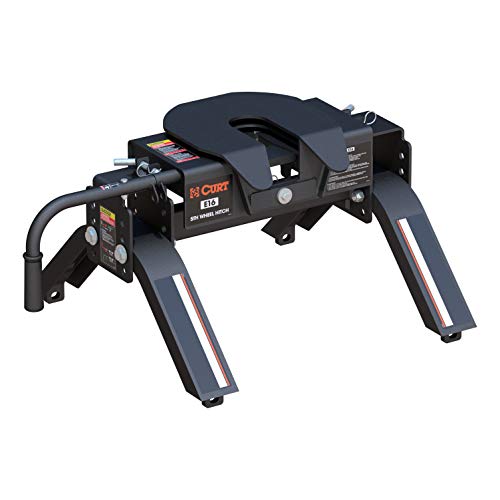
- Best for: Long-bed pickups with standard rails towing fifth wheels under 16,000 lb.
- Model: 16115
- Mount: industry-standard base rails, rails and brackets sold separately
- Gross trailer weight capacity: 16,000 lb
- Vertical load capacity: 4,000 lb
Long-bed pickups with standard rails towing fifth wheels under 16,000 lb.
The listing marks this model discontinued by the manufacturer, so confirm the seller has stock before you order; the fixed head is not the right pick for a short bed.
The CURT E16 16115 is the straightforward rail-mount route for a long-bed truck that already carries industry-standard base rails, or is getting them fitted for this hitch. Its dual-pivoting head moves 10 degrees laterally, which takes some strain out of coupling on ground that is not level, and an anti-rattle skid plate keeps the slide-bar jaw quieter than the basic design suggests. Four height settings run from 13 to 17 inches, so matching the trailer ride height is a bolt-hole decision rather than a compromise. Head and legs are in the box; rails and brackets are not.
Which One Fits Your Situation
Your truck already has a B&W Turnoverball
If a Turnoverball socket is already under the bed, the Companion RVK3500 is the natural fit. It uses the hardware you own, skips rails entirely, and lifts out in two pieces when the truck goes back to daily work. Just confirm the trailer stays within its 20,000 lb gross and 5,000 lb vertical figures before you commit.
You tow a heavy fifth wheel with a Ford Super Duty
A Ford truck with the factory prep package and a trailer pushing past 20,000 lb loaded points straight at the Companion OEM RVK3305. Its 25,000 lb capacity is the headroom the others here cannot match, and the puck mount keeps the bed clean between trips. The trade is weight: at 161 lb, removal is a two-person job.
Your 2016-2019 GM HD has the factory puck system
For a Silverado or Sierra HD from those years, the Companion OEM RVK3700 matches the puck pattern your truck was built with. It carries 20,000 lb, splits into base and coupler for easier handling, and leaves a flat bed floor once removed. Measure your puck layout against the listing first, because the newer GM pattern is different.
Your long bed already has standard rails
Trucks with industry-standard rails already bolted in, and a trailer that stays under 16,000 lb loaded, are the E16’s home ground. It is the lightest unit here at 95 lb, the height adjusts across four settings, and the head and legs are included. Keep the discontinued flag in mind and verify stock with the seller before ordering.
Common Mistakes
- Buying a puck hitch for the wrong brand, or for the wrong model years, since GM changed its puck layout after 2019.
- Checking gross trailer weight but forgetting pin weight, which can run past the vertical load figure on a heavy trailer.
- Assuming base rails and brackets come in the box with a rail-mount hitch, when the listing sells them separately.
- Putting a fixed hitch in a short bed, then finding the trailer corner at the cab in the first tight turn.
- Treating the hitch capacity as the truck’s capacity, when the truck’s own limit may sit well below it.
Frequently Asked Questions
Can I install one of these hitches myself?
Puck and single-point models drop in without drilling, so a careful owner can fit them at home. Rail hitches need brackets mounted under the bed, which is a bigger job. Either way the units weigh 95 to 161 lb, so bring a second person or a hoist, and follow the torque figures in the manual.
What is the difference between a puck system and base rails?
Pucks are reinforced mounting points built into the bed floor by the truck maker, and the hitch locks into them directly and removes cleanly. Base rails are steel bars bolted across the bed floor that stay in place, with the hitch pinned on top. Both hold the hitch securely; the truck you own decides which route is open.
Will a fifth wheel hitch fit my short bed truck?
A short bed needs clearance between the trailer nose and the cab in tight turns, which calls for a sliding hitch that shifts the pivot point rearward. All four hitches in this roundup are fixed designs aimed at long beds, so short-bed owners should look at slider models built for their truck instead of forcing one of these to fit.
Does a 25,000 lb hitch let my truck tow 25,000 lb?
No. The working limit is the lowest figure among the truck, the hitch and the trailer hardware, and the truck’s limit often sits below the hitch figure. Pin weight also counts against the truck’s payload. Check both numbers for your exact truck before treating any single capacity figure as permission to tow.