Key takeaways
- Three 5W-40 full synthetic oils meeting Chrysler MS-12991 for the 3.0L EcoDiesel, compared by pack size, approvals and the quantity a change requires.
The real decision with this engine is not which 5W-40 to grab, but whether the bottle in your hand carries the one approval the 3.0L EcoDiesel actually asks for: Chrysler MS-12991. Store shelves are full of 5W-40 diesel oils built for heavy-duty truck engines, and almost none of them print that specification. Running an oil without it loads the particulate filter with ash it cannot burn off, and the savings at the register turn into a much larger repair later.

This guide is for Ram 1500 and Jeep owners who change their own oil and want the approval question settled before they drain the pan. Every pick below was chosen because its Amazon listing prints MS-12991 in the approval list for that exact product, not because the brand makes a compliant oil somewhere else in its catalog. The three are compared on pack format, the rest of their approval stack, and how their container sizes line up with the quantity this engine takes at each change.
Quick Picks
As an Amazon Associate we earn from qualifying purchases.
| Product | Best for | Key spec from title |
|---|---|---|
| Pennzoil Platinum Euro 5W-40, 6 Pack | Owners who want the factory-connected name | 5W-40 full synthetic, MS-12991 listed |
| Castrol EDGE Euro 5W-40 A3/B4, Pack of 6 | High-mileage trucks that tow | 5W-40 full synthetic, ACEA A3/B4 |
| Mobil 1 European Car Formula 5W-40, 6 Quarts | Drivers who value long drain protection | 5W-40 full synthetic, 10,000-mile protection claim |
How to Choose
Start With the MS-12991 Line, Not the Viscosity Grade
Two oils can share the 5W-40 grade and have almost nothing else in common. The EcoDiesel was designed around FCA material standard MS-12991, which fixes the grade, the additive chemistry and the ash level in one specification. Heavy-duty diesel oils with API CK-4 on the label are formulated for Cummins, Duramax and Power Stroke engines and answer to a different standard entirely. Before you compare anything else, flip to the approval list on the listing and find MS-12991 printed next to the Chrysler name. If it is missing, the oil is wrong for this engine no matter how familiar the brand feels.
Understand Why Ash Content Matters Here
Every EcoDiesel runs a diesel particulate filter, and the filter traps more than soot. The metallic additives in engine oil leave behind sulfated ash that collects in the filter permanently, because ash does not burn away during regeneration the way soot does. Oils built to MS-12991 keep that ash contribution within the limit the aftertreatment system was sized for. This is also why topping off between changes with whatever quart is sitting in the garage is a quiet mistake: a few top-offs with a high-ash truck oil undo the care you took choosing the main fill.
Buy Enough for the Sump You Actually Have
This engine does not take a single five-quart jug, and the required fill changed between the earlier and later versions of the 3.0L, so the quantity in an old forum post may not match your truck. Check the capacity in your owner’s manual before ordering, then count containers against that number. Six-quart cases simplify the math for the later trucks and leave a sealed bottle for top-offs, while earlier trucks need a case plus extra bottles. Running short mid-change means a second order, a delayed refill, or the temptation to finish the fill with a non-spec oil.
Match the Pack Format to How You Work
Individual quart bottles cost you a funnel-and-measure step for every quart, but they make partial fills and top-offs exact, and an unopened bottle stores cleanly in the truck. A large jug pours faster and suits owners who change oil on a fixed schedule and use the whole container at once. Cases of quarts also travel better if you buy ahead for two changes. None of this changes what is inside, so let the format follow your routine: the approval line matters, the packaging only decides how tidy the job feels.
The 3 Best Options
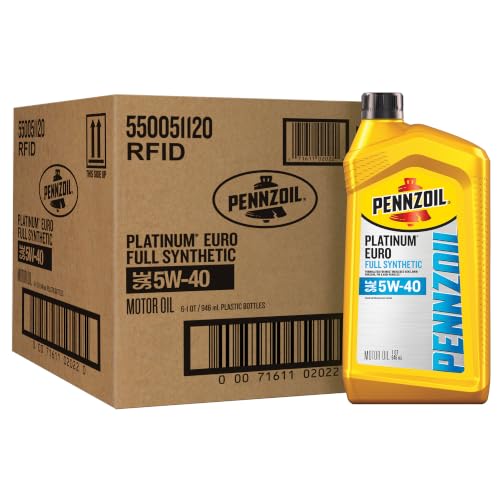
Pennzoil Platinum Euro Full Synthetic 5W-40, 1 Quart (6 Pack)
Pennzoil is the name most EcoDiesel owners already associate with this engine, and this listing earns the spot on its own paperwork: the approval list printed for this product includes Chrysler MS-12991 alongside MS-10725 and MS-10850. The description frames it as an oil designed to maximize protection for modern light-duty diesel and high-performance engines, which is exactly the duty cycle of a Ram or Jeep 3.0L. Because it is made from natural gas base stock, the brand leans on cleanliness claims, and the six-bottle case suits the larger fills this engine needs while leaving one sealed quart for the road.
Specs
- Viscosity: SAE 5W-40
- Type: Full synthetic, made with natural gas
- Approvals in listing: Chrysler MS-12991, MS-10725, MS-10850; Fiat 9.55535-Z2 and 9.55535.N2; BMW LL-01; MB 226.5/229.3/229.5; Porsche A40; Renault RN0700 and RN0710; VW 502 00 and 505 00
- Pack: Six 1-quart bottles, 192 fluid ounces total
- Part number: 550051120-6PK
- Brand warranty: Up to 15 years or 500,000 miles, enrollment terms apply
Best for: Owners who want the oil whose listing speaks this engine’s language most directly.
Watch out for: The same Pennzoil Euro family includes a 5W-30 Euro L line that does not carry MS-12991, so confirm the 5W-40 grade on the label before you pour.
Castrol EDGE Euro 5W-40 A3/B4, 1 Quart, Pack of 6
Castrol’s entry is the workhorse pick of the three. Its listing leads with the European approval stack, ACEA A3/B4 and API SP up front, and includes Chrysler MS 12991 among the manufacturer approvals it meets, which is the line that qualifies it for the EcoDiesel. The brand copy emphasizes viscosity control and engine cleanliness measured against test limits, two traits that matter on trucks that tow, idle in traffic, or stretch changes toward the oil-life monitor’s limit. The six individual quarts pour and store like the Pennzoil case, so switching between the two brands costs you nothing in routine.
Specs
- Viscosity: SAE 5W-40
- Type: Advanced full synthetic
- Standards in listing: ACEA A3/B4, API SP
- Approvals in listing: BMW Longlife-01, MB-Approval 229.5, Porsche A40, Renault RN0700 and RN0710, VW 502 00 and 505 00, Chrysler MS 12991
- Listing claims: 1.2X better viscosity control and 2X better engine cleanliness, as measured in the DV6 test against the test limit
- Pack: Six 1-quart bottles
- Model number: 06249
Best for: Trucks that tow or run long highway miles between changes.
Watch out for: Castrol sells this oil in several pack sizes under near-identical names, so check that the listing you open shows the A3/B4 version with MS 12991 in its approvals.
Mobil 1 European Car Formula Full Synthetic 5W-40 (6 Quarts)
Mobil 1’s European Car Formula is the pick for drivers who think in drain intervals. The listing states the oil protects critical engine parts for up to 10,000 miles between changes, supports that with internal heat protection up to 500 degrees Fahrenheit, and adds low-temperature protection down to minus 40 degrees for cold starts. Its brand approval list includes the Chrysler MS 12991 engine test requirements, which is what places a gasoline-and-diesel European formula in an EcoDiesel guide at all. The case format keeps measuring simple, and the uniform synthetic molecule story in the description targets deposit and sludge control.
Specs
- Viscosity: 5W-40
- Type: Full synthetic
- Protection claim in listing: Up to 10,000 miles between oil changes, or one year
- Temperature claims in listing: Internal heat protection up to 500 degrees Fahrenheit; low-temperature protection to -40 degrees Fahrenheit
- Approvals in listing copy: Meets Chrysler MS 12991 engine test requirements; ACEA A3/B4; API SP
- Pack: Six 1-quart bottles
- Part number: 126232
Best for: Owners who run the oil-life monitor to its limit and want the interval claim in writing.
Watch out for: The 10,000-mile figure is an upper claim under the brand’s conditions, so severe towing, short trips and dusty work still argue for following the truck’s monitor instead of the bottle.
Which One Fits Your Situation
Your Truck Is a Later EcoDiesel Still Under Factory Coverage
Choose the Pennzoil. When a warranty conversation ever turns to oil, the easiest position is a fill whose listing prints the exact factory specification from the brand most closely tied to this engine program. Keep the empty bottles or the order record with your service receipts, follow the oil-life monitor rather than a fixed mileage guess, and your maintenance file tells a clean story if a dealer ever asks what went into the sump.
You Tow, Haul or Spend Hours at Highway Speed
Choose the Castrol. Sustained load is where viscosity control stops being a brochure phrase, because a working truck holds oil temperature high for hours at a time. Castrol’s listing puts its viscosity control and cleanliness numbers at the center of the pitch, and the MS 12991 approval keeps the particulate filter out of the compromise. Buy a second case when you order, since towing schedules rarely align with shipping schedules.
You Do Your Own Changes on a Driveway Schedule
Choose the Mobil 1. The six-bottle case measures out cleanly, the stated protection window matches how most owners actually use the oil-life monitor, and the cold-start figure matters if the truck sleeps outside through winter. Set a recurring reminder tied to the monitor rather than the calendar, keep one bottle aside for top-offs, and each change becomes a single-container job with nothing left to store half-open.
Your Manual Still Shows the Older 5W-30 Fill
Choose any of the three, and choose the 5W-40. Early EcoDiesel manuals printed a 5W-30 recommendation, and FCA later moved the whole engine family to 5W-40 meeting MS-12991. The older page in your glovebox is not a loophole; it is an outdated instruction. All three listings here meet the current specification, so the decision between them comes back to pack format and the approval wording you prefer to see in print.
Common Mistakes
- Buying a heavy-duty 5W-40 diesel oil with API CK-4 on the label and assuming the grade alone makes it suitable, when the listing never mentions MS-12991.
- Following the 5W-30 recommendation printed in an early owner’s manual instead of the current 5W-40 MS-12991 specification for this engine.
- Ordering a single five-quart jug for an engine whose fill is larger than that, then finishing the job with whatever oil is on the shelf.
- Topping off between changes with a non-spec quart, which quietly adds ash load the particulate filter cannot burn away.
- Stretching the interval past the oil-life monitor because the oil still looks clean on the dipstick.
Frequently Asked Questions
Does Shell Rotella T6 work in the 3.0L EcoDiesel?
It is a respected heavy-duty diesel oil, but its listing is built around API CK-4 and the approvals for larger truck engines, and it does not print Chrysler MS-12991. The EcoDiesel asks for that specification by name in the manual. Until a listing for it shows MS-12991 in the approval list, it does not belong in this engine, whatever its reputation in the Cummins world.
What does MS-12991 actually control?
It is FCA’s standard for this engine, and it fixes more than viscosity. The standard sets the 5W-40 grade, the additive chemistry and the sulfated ash ceiling that protects the particulate filter, along with wear and deposit performance targets. An oil either prints the specification in its approvals or it does not, which is why the approval list on the listing is the only page that matters when you buy.
How much oil should I order for one change?
More than a single five-quart jug, and the exact fill differs between the earlier and later versions of this engine, so read the capacity in your owner’s manual before ordering. Six-quart cases cover the later trucks with a bottle to spare for top-offs. Earlier trucks take more, so plan on a case plus extra bottles rather than discovering the shortage with the drain plug already out.
Can I mix two of these oils during a top-off?
All three meet the same specification, so a top-off with a different pick from this list is far safer than reaching for a non-spec quart. That said, treat mixing as a bridge to the next change, not a habit. Additive packages differ between brands, and the cleanest routine is one oil per fill, with the same product kept on hand for the small additions between services.